Recall scope
When a material lot is found out of specification, the affected work orders, finished batches, shipments, and customers are identified and listed in full by level.

Knowledge graph analysis
The decisive questions in regulated manufacturing cross multiple systems and tables. PhaseNext holds the relationships between material lots, work orders, finished batches, shipments, equipment, and SOP versions as governed data, so four classes of quality and change control questions are answered from one basis.
Book a demoFour questions
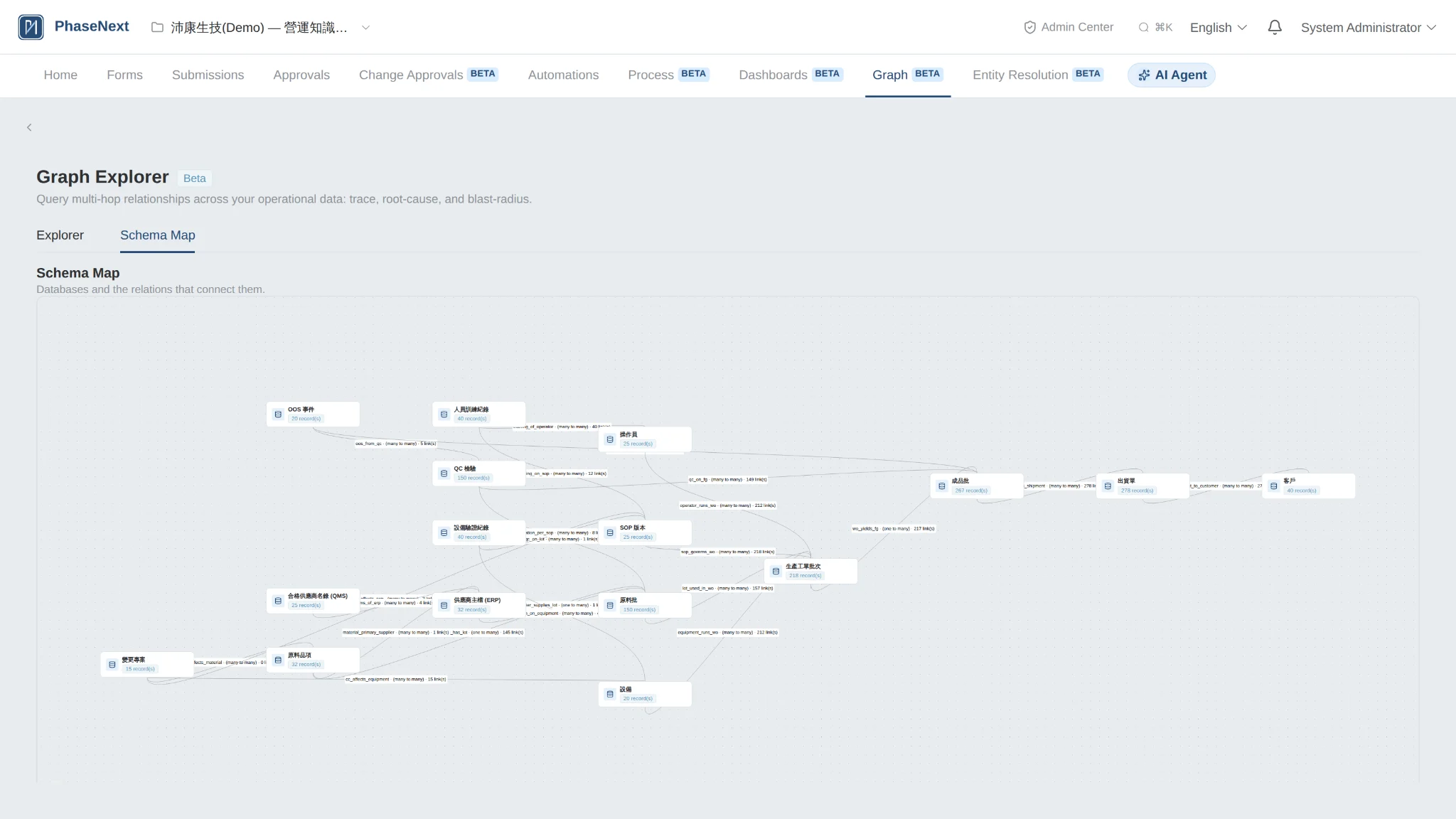
When a material lot is found out of specification, the affected work orders, finished batches, shipments, and customers are identified and listed in full by level.
Across a period of out-of-specification batches, the shared equipment, SOP versions, and operators are identified and ranked by how widely they are shared.
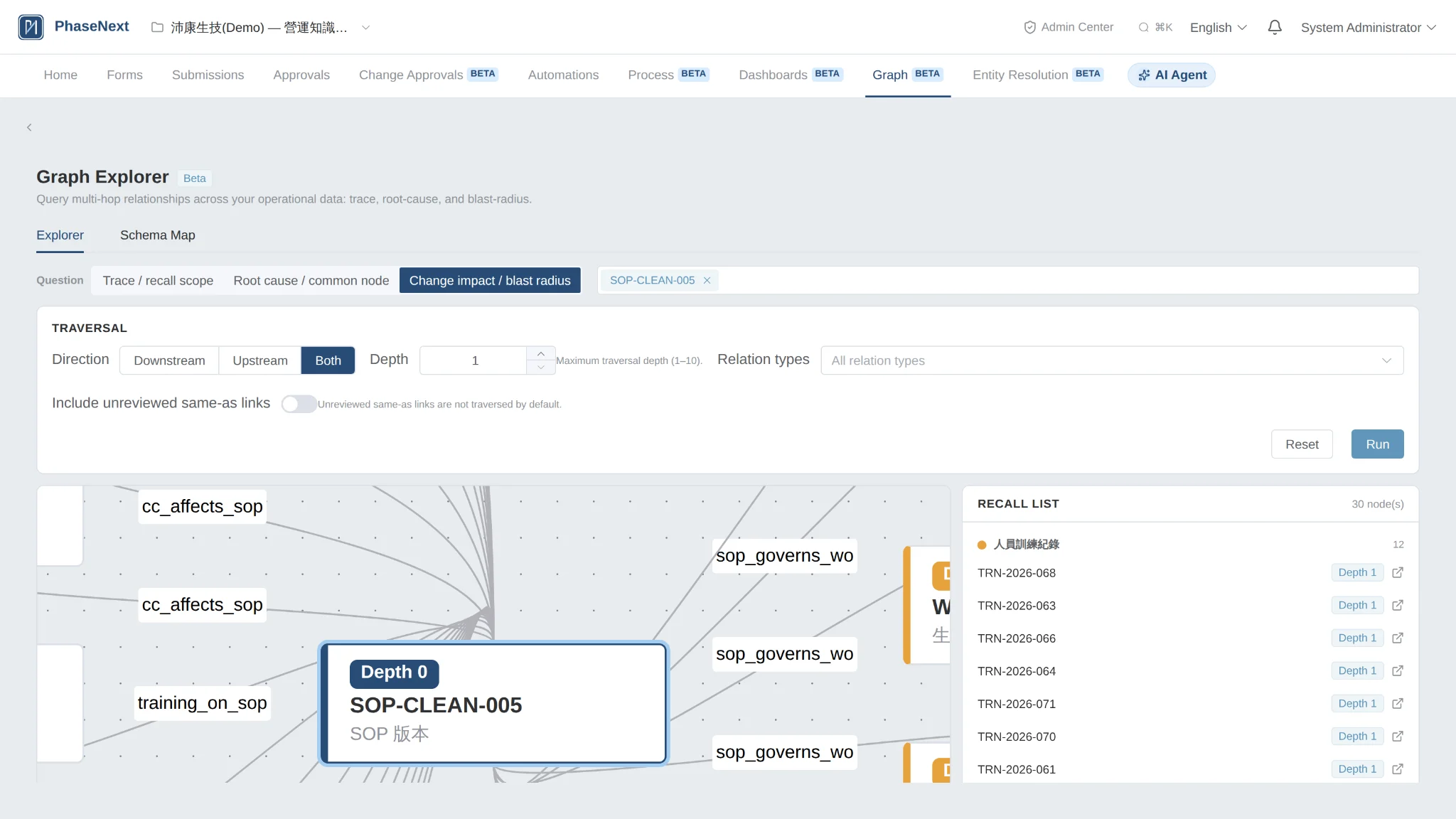
Before an SOP is revised, the affected equipment qualifications, training records, open work orders, and change projects are listed as the basis for change control review.
Where a supplier is registered under different names in ERP and QMS, the records resolve to a single entity so a query covers the full scope.
Query and result
A query starts from one record and expands by direction and level, with relation types available as a constraint. The result provides both the relationship view and the complete list, and each entry carries its level and a link back to the original record for verification.
Audit completeness
Audited manufacturing requires the complete recall set. Silent truncation counts as a defect.
Governance
Candidates are scored across mapped fields and split into matched, ambiguous, and rejected bands, with each pair approved or returned by a reviewer. A merge writes a link and preserves the original records.
A job advances through draft, preview, confirm, and apply. Apply is a manual action, and the confirming user differs from the creator.
Resolved identities carry versions and effective dates. A query run against an earlier date returns the membership frozen at that point, so the same recall returns the same result on any date.
Permission and AI boundaries
Queries apply workspace and database permissions at every level. Branches beyond a permission boundary stop at that line and the result is marked incomplete, with the identity, count, and structure on the far side withheld. A formal recall report is run by a user with full access. The AI entry point turns a question into query conditions, the deterministic engine produces the result, and every conclusion in a summary carries a relation path that can be checked.
Traceability demo